

The Government of Lagos State has made known, it is monitoring the evolving outbreak of ebola in Central and East Africa as it reassured residents “no cause for alarm”.
The State’s Commissioner for Health Prof. Akin Abayomi said, Lagos State is completely ready to “detect, contain and respond rapidly” to any biological threat.
This was announced via a Statement from the Lagos State Government on Tuesday 26 May, 2026.
The Statement reads: “Lagos State Government has reassured residents that there is no cause for alarm over the evolving Ebola outbreak in Central and East Africa. Besides, the state’s robust and tested biosecurity architecture remains fully activated and prepared to detect, contain and respond rapidly to any biological threat, Commissioner for Health Prof. Akin Abayomi has said.”
Ebola Virus Disease (EVD) remains restrained within Congo and Uganda, however, Babajide Sanwo-Olu, Executive Governor of Lagos State, has directed keen vigilance over developments as regards the outbreak.
The outbreak of the zoonotic viral hemorrhagic fever in humans and other primates has been declared a Public Health Emergency of International Concern (PHEIC) by the World Health Organization (WHO).
The Statement reads: “Following directives from Governor Babajide Sanwo-Olu, Lagos State is closely monitoring developments surrounding the outbreak, which has so far recorded approximately 177 deaths from nearly 700 suspected cases and remains confined to two countries – Congo and Uganda.
“The World Health Organisation (WHO) has declared the outbreak a Public Health Emergency of International Concern (PHEIC), owing largely to the difficult terrain in the affected areas, which may challenge local and international public health response efforts.”
The Commissioner reassured Lagosians, currently, there is no identified case of the virus in Lagos. He said, the Southwestern State has established a “resilient and outbreak-tested” biosecurity system over the years, that means it is prepared to respond to diseases such as, ebola, Lassa fever, which are “high-consequence infectious diseases”.
According to the Statement: “The World Health Organisation (WHO) has declared the outbreak a Public Health Emergency of International Concern (PHEIC), owing largely to the difficult terrain in the affected areas, which may challenge local and international public health response efforts.
“Prof. Abayomi, on behalf of the leadership of the Ministry of Health, reassures Lagos residents that, as of now, no case suggestive of Ebola Virus Disease has been identified within Lagos State.
“Lagos has, over the years, built a resilient and outbreak-tested biosecurity system designed for continuous year-round preparedness and response against high-consequence infectious diseases, including Ebola, Lassa Fever and Influenza.”
The Commissioner identified key components of the State’s permanent readiness architecture, which include, the “Lagos State Incident Command System (ICS), which is led directly by Governor Babajide Olusola Sanwo-Olu as Incident Commander.
“The Lagos State Emergency Operations Centre (EOC) remains operational around the clock, conducting disease surveillance and gathering real-time public health intelligence.
“The Lagos Mainland Hospital, also known as the Lagos State Infectious Disease Hospital (IDH), Yaba, continues to maintain a state of readiness through its infectious disease specialists, dedicated triage systems.
“The Biosafety Level-3 Laboratory and Biobank Facility located within the hospital remains on enhanced surveillance operations for the real-time diagnosis and monitoring of high-risk pathogens.”
The Lagos State Government is working closely with “Port Health Authorities at the Murtala Muhammed International Airport, as well as land and sea points of entry in partnership with the Federal Ministry of Health, Federal Airports Authority of Nigeria (FAAN), Nigeria Centre for Disease Control (NCDC), Nigeria Institute of Medical Research (NIMR) and other critical agencies”.
All flights from East and Central Africa are taken seriously with increased public health attention. Prof. Abayomi advised those who travelled to Congo or Uganda recently to immediately go for guidance via emergency channels.
The Statement further reads: “All flights arriving from East and Central Africa are receiving heightened public health attention and scrutiny as part of precautionary measures to strengthen early detection and risk mitigation.
“Abayomi advised residents, particularly those who recently travelled to affected areas in Congo or Uganda, or who have had close contact with individuals returning from those countries and have medical concerns, to promptly seek guidance through emergency channels.”
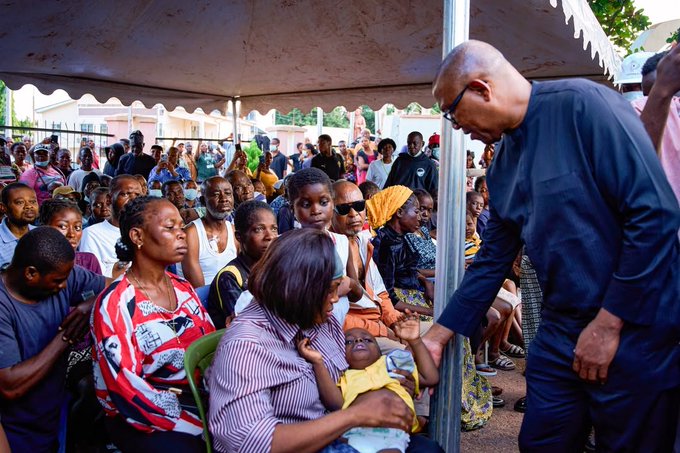
Photo: A member of the Congo Scouts movement, speaks to people during a public sensitisation campaign amid the Ebola outbreak in Bunia, Congo | AP